Professor Ian Ralston
Research Interests
My interests include temperate European Iron Age social and political dynamics, particularly as evidenced in the settlement record, including the post-Roman Iron Age of Scotland, and especially that associated with the Picts. My direct field experience in France has been focused on central France: at Levroux (Indre) and more generally in Berry; in Limousin; and in Burgundy, more particularly at mont Beuvray. Much of this interest has been concerned with the emerging complexity, initially of the Late Iron Age but in more recent years also that apparent in the sixth-fifth centuries BC, of the Late Iron Age of this and neighbouring regions. Since the mid-1990s until c. 2012, I worked in collaboration with Dr Olivier Buchsenschutz (CNRS Ecole normale superieure, Paris), Mr Jacques Troadec and Mme Laurence Augier (and their staff: Service archéologique de Bourges-Plus) and Dr Pierre-Yves Milcent (Université de Toulouse-le-Mirail) on the evidence for a precocious and outsize protourban settlement at Bourges datable to around the fifth century BC.
I continue to be involved at least tangentially in fieldwork and excavation in Berry, including providing advice (with my colleague Olivier Buchsenschutz) e.g. on the major excavations undertaken at Châteaumeillant by my colleague Professor Sophie Krausz (Université de Paris 1 -Panthéon-Sorbonne). Since 1995 my main effort has been at and around Bourges, in Cher (see bibliography). In 2009 I undertook small-scale exploratory work in the Bourbonnais with Dr Patrick Pion, Université de Paris X (Nanterre) at the vitrified and calcined promontory fort of the Eperon des Charmes, at Bègues, Allier and in 2011 examined a small enclosed site defended by a murus gallicus at Meunet-Planches, Indre, again with Dr Buchsenschutz.
Work at Bourges since 1995 has included excavations around the southern periphery of the town (in the Auron valley – now published), in the core of the town (including the Hôtel-Dieu site: now published) and on its eastern edge (Port Sec Nord and Sud: also now published). At the last-mentioned site, major collaborative excavations, covering in excess of 15ha, revealed fifth century BC workshops and associated features accompanied by a suite of Mediterranean imports. The budget has been met very largely from French sources and was administered by the Communauté de Communes de Bourges-Plus, as successor to the Ville de Bourges. I continue to publish pieces interpreting the results of these and other interventions at Bourges.
This work on late Hallstatt and early la Tène Bourges formed part of wider programmes in eastern France and western Germany, which included a German Schwerpunktprogramm, directed by Professor Alfred Haffner and the late Dr Jörg Biel (Esslingen).
I have edited (2006: with Professor John Hunter, University of Birmingham) the second, substantially updated and revised version of Archaeological Resource Management in the UK. Historic Scotland published research (with Andrew Dunwell) on the management of cropmark archaeology in eastern Scotland in 2008.
I published a small synthesis on Pictish hill-forts in 2004, and am taking forward publication of my fieldwork at Green Castle, Portknockie and (to 2006) at Burghead in Moray. A synthesis (with Andy Dunwell, CFA Archaeology) developed from the major fieldwork undertaken in Angus conducted as part of the Department of Archaeology’s ASAP student training school project, but privatized as a result of the university’s decision to disengage from applied field archaeology, appeared in 2008. I have other post-excavation/publication work underway on this area, notably on Balbridie Timber Hall (Aberdeenshire) and that excavated by the late Dr Brian Hope-Taylor at Doon Hill (Dunbar: East Lothian) in the mid-1960s. In the case of the latter, I have been able to demonstrate that the site is largely Early Neolithic in date – including both its major buildings – and that none of the evidence fits the British-to-Anglian first millennium AD hypothesis advanced by Hope-Taylor.
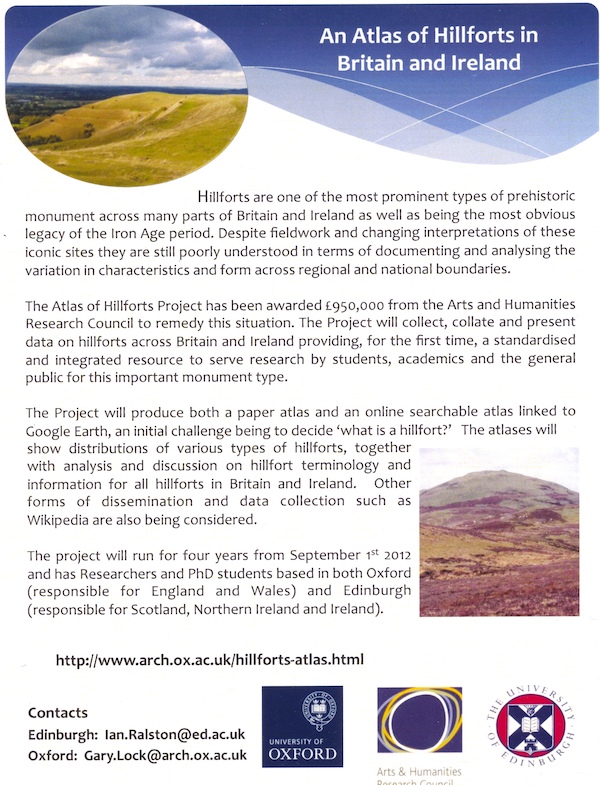
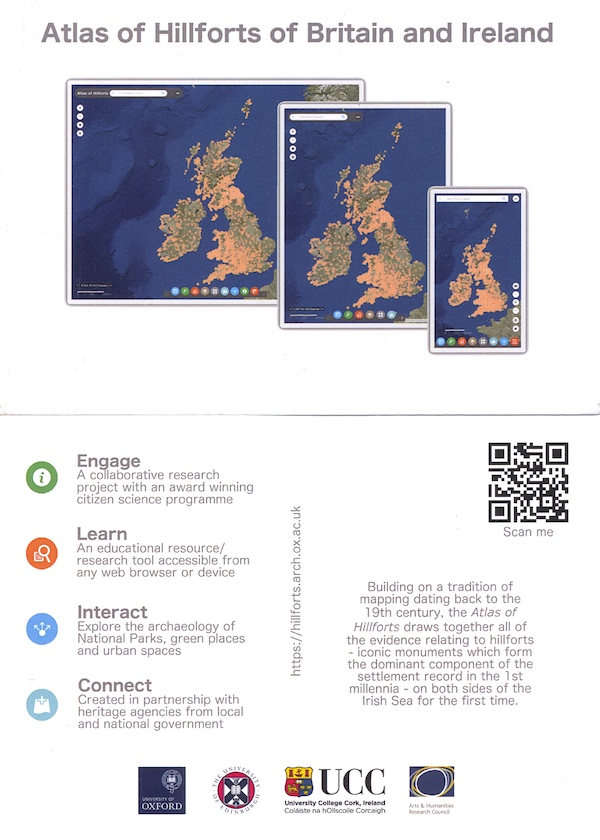
Although no longer actively involved in fieldwork at Mont Beuvray, I am still monitoring change at the Porte du Rebout, reconstructed in association with the architects of the Service des Monuments historiques, Dijon at a cost of c. £0.25m. A general book on hillfort defences in Britain and beyond was published by Tempus in 2006 (revised edition 2013). Aside from the small-scale work at Bègues (mentioned above), I have maintained a long-standing interest in vitrified forts and experimentation, on which I have worked with Professor David Sanderson (SUERC, University of Glasgow) and Dr Patrick Pion. In autumn 2012, I began a four-year major project funded by AHRC to produce an Atlas of Hillforts in Britain and Ireland run jointly with my Oxford colleague, Emeritus Professor Gary Lock. The project was staffed by Dr Ian Brown, Mr Strat Halliday and Dr Paula Levick and we had considerably help for Ireland from Professor William O'Brien and colleagues (Drs James O'Driscoll and Alan Hawkes) at University College Cork. The Atlas – in the form of all the data for the 4000-plus sites considered - is now accessible online at https://hillforts.arch.ox.ac.uk/ and the volume of papers arising from the end-of-project conference was published by Archaeopress (Oxford) in mid-2019. The final volume, entitled The Atlas of the Hillforts of Britain and Ireland, appeared in February 2022 from Edinburgh University Press.
I have contributed papers on the first two Abercromby Professors of Archaeology at Edinburgh (Gordon Childe, FBA 1927-1946: European Journal of Archaeology 12, 2009) and Stuart Piggott, FBA 1946-1977: Ralston & Megaw 2004); and on the ‘discovery’ of timber roundhouses in excavation. More recently, as well as pursuing aspects of Childe's career in Scotland, I have published with Professor David Breeze and Dr Rosalind Marshall short papers on Margaret Simpson, an early student of Gordon Childe's who became the first female professional archaeologist in Scotland.
I am no longer accepting postgraduate students as first supervisor. I am supervising (as second supervisor) one doctoral student working on souterrains in Scotland (with Dr Manuel Fernández-Götz).